Can a Pure Culture Be Prepared From a Mixed-broth or a Mixed-agar-slant Culture
The Birth of Bacteriology
While perhaps best known to us every bit a cause of homo disease, bacteria actually should be far more famous for their positive contributions than for their negative ones. Beneath, list three positive things that bacteria do for yous.
- ______________________________________________________________________
- ______________________________________________________________________
- ______________________________________________________________________
Bacteria were get-go observed by Anton von Leeuwenhoek in the late 17th century, merely didn't become the objects of serious scientific study until the 19th century, when information technology became apparent that some species caused human diseases. The methods devised by Robert Koch, Louis Pasteur, and their associates during the "Gilt Age" of microbiology, which spanned from the mid-1800s to early 1900s, are still widely used today. Near of these methods involved isolating single bacteria derived from a natural source (such as a diseased creature or human) and cultivating them in an artificial environment as a pure culture to facilitate boosted studies.
During the heart of the twentieth century, when we believed nosotros had defeated them at their disease-causing game, bacteria became pop subjects of empirical study in fields such equally genetics, genetic engineering science, and biochemistry. With the evolution of antibiotic-resistant strains and our increased knowledge of bacterial stealth attack strategies such as biofilms and intracellular growth, medical researchers have refocused their attention on affliction-causing bacteria and are looking for new means to defeat them.
Growing bacteria in pure culture is still one of the nearly widely used methods in microbiology. Many bacteria, particularly those that cause diseases and those used in scientific studies, are heterotrophic, which ways that they rely on organic compounds as food, to provide energy and carbon. Some leaner also require added nutritional components such equally vitamins in their diet. An advisable physical environment must be created, where important factors such as temperature, pH, and the concentration of atmospheric gases (specially oxygen) are controlled and maintained.
The nutritional needs of bacteria can exist met through specialized microbiological media that typically comprise extracts of proteins (equally a source of carbon and nitrogen), inorganic salts such as potassium phosphate or sodium sulfate, and in some cases, carbohydrates such as glucose or lactose. For captious bacteria (meaning, those that are picky eaters) vitamins and/or other growth factors must be added as well.

Figure one. Different types of culture
Bacteriological culture media tin can exist prepared as a liquid (broth), a solid (plate media or slant media), or equally a semi-solid (deeps) as illustrated in Figure ane. Solid and semi-solid media contain a solidifying agent such every bit agar or gelatin. Agar, which is a polysaccharide derived from red seaweed (Rhodophyceae) is preferred considering it is an inert, non-nutritive substance. The agar provides a solid growth surface for the bacteria, upon which bacteria reproduce until the distinctive lumps of cells that we telephone call colonies form.
Koch, Pasteur, and their colleagues in the 19th and early 20th centuries created media formulations that contained moo-cow brains, potatoes, hay, and all sorts of other enticing microbial edibles. Today, bacteriological media formulations can be purchased in powdered form, so that all the preparer has to do is to measure out out the correct amount, add the right corporeality of water, and mix. After the basic formula has been prepared, the medium is sterilized in an autoclave, which produces steam under pressure level and achieves temperatures above boiling. Once sterilized media has cooled, it is set up to be used.
Growing Bacteria in Culture
A population of leaner grown in the laboratory is referred to as a culture. A pure culture contains only 1 single type; a mixed culture contains two or more unlike bacteria. If a bacterial culture is left in the aforementioned media for too long, the cells use up the available nutrients, excrete toxic metabolites, and eventually the entire population will die. Thus bacterial cultures must be periodically transferred, or subcultured, to new media to keep the bacterial population growing.
Microbiologists use subculturing techniques to grow and maintain bacterial cultures, to examine cultures for purity or morphology, or to determine the number of viable organisms. In clinical laboratories, subculturing is used to obtain a pure civilization of an infectious agent, and also for studies leading to the identification of the pathogen. Because leaner can live almost anywhere, subculturing steps must be performed aseptically, to ensure that unwanted bacterial or fungal contamination is kept out of an important culture.
In microbiology, aseptic techniques essentially require merely common sense and good laboratory skills. First, consider that every surface yous touch and the air that y'all breathe may be contaminated by microorganisms. Then think about the steps you tin accept to minimize your exposure to unwanted invisible intruders. You should also be thinking about how to forestall contamination of your bacterial cultures with bacteria from the surrounding environment (which includes you).
To maintain an aseptic work environs, everything you work with should exist initially free of microbes. Thus, we brainstorm with pre-sterilized pipettes, culture tubes, and glassware. Inoculating loops and needles made of metal wire can be used to transfer bacteria from 1 medium to some other, such as from the surface of an agar plate to a broth. Metal tools may be sterilized past heating them in the flame of a Bunsen burner. Drinking glass tools or metal spreaders or forceps that can't be sterilized by direct estrus are dipped in alcohol followed by a brief pass through the flame to speed the evaporation process. Standard hygienic techniques used for culturing leaner volition be demonstrated at the outset of lab.

Figure 2. Colonies on an agar plate
One very important method in microbiology is to isolate a single blazon of bacteria from a source that contains many. The most effective way to do this is the streak plate method, which dilutes the private cells by spreading them over the surface of an agar plate (see Effigy 2). Unmarried cells reproduce and create millions of clones, which all pile up on superlative of the original cell. The piles of bacterial cells observed after an incubation period are chosen colonies. Each colony represents the descendants of a single bacterial cell, and therefore, all of the cells in the colonies are clones. Therefore, when y'all transfer a unmarried colony from the streak plate to new media, yous take achieved a pure culture with just one type of leaner.
Different bacteria give rise to colonies that may be quite singled-out to the bacterial species that created information technology. Therefore, a useful preliminary step in identifying bacteria is to examine a characteristic chosen colonial morphology , which is divers equally the appearance of the colonies on an agar plate or slant. Ideally, these determinations should exist made past looking at a single colony; nonetheless, if the colonial growth is more abundant and single colonies are absent, it is yet possible to describe some of the colonial characteristics, such as the texture and colour of the bacterial growth.
Describing Colonial Morphology of Bacteria
By looking closely at the colonial growth on the surface of a solid medium, characteristics such as surface texture, transparency, and the color or hue of the growth can be described. The following iii characteristics are readily apparent whether you're looking at a unmarried bacterial colony or more dense growth, without the aid of whatever type of magnifying device.
Texture—describes how the surface of the colony appears. Common terms used to describe texture may include smooth, glistening, mucoid, slimy, dry, powdery, flaky etc.
Transparency—colonies may exist transparent (you can see through them), translucent (lite passes through them), or opaque (solid-appearing).
Color or Pigmentation—many bacteria produce intracellular pigments which cause their colonies to announced a distinct colour, such as yellow, pink, imperial or cherry. Many bacteria do not produce any pigment and announced white or grayness.

Effigy 3. Bacteriological descriptions of colonial morphology
As the bacterial population increases in number, the colonies get larger and brainstorm to accept on a shape or form. These tin exist quite distinctive and provide a skilful manner to tell colonies apart when they are similar in colour or texture. The following 3 characteristics tin be described for leaner when a single, separate colony can be observed. It may exist helpful to apply a magnifying tool, such as a colony counter or dissecting microscope, to enable a shut-upward view of the colonies. Colonies should be described as to their overall size, their shape or form, what a close-up of the edges of the colony looks like (edge or margin of the colony), and how the colony appears when y'all discover information technology from the side (acme).
Figure four shows a close-up of colonies growing on the surface of an agar plate. In this example, the differences between the two bacteria are obvious, because each has a distinctive colonial morphology.

Figure iv. Two different types of bacterial colonies on an agar plate.
Using microbiology terms, describe fully the colonial morphology of the two colonies shown in a higher place. A full description will include texture, transparency, color, and form (size, overall shape, margin, and superlative).
Now depict the colonial morphology of Micrococcus luteus, using the TSA plate civilisation of this bacterium provided to your group at the start of lab:
Size: ___________________________________________________________________
Texture: ________________________________________________________________
Transparency: ___________________________________________________________
Pigmentation: ___________________________________________________________
Form (shape, margin, elevation): ____________________________________________
Media Considerations
A culture medium must incorporate adequate nutrients to support bacterial growth. Minimally, this would include organic compounds that can provide the building blocks necessary for cellular reproduction. In many cases, predigested protein, such as hydrolyzed soy poly peptide, serves this purpose and will support the growth of many different bacteria. These media formulations are more often than not referred to every bit complex media, to indicate that it is a mixture with many components.
Many media contain additional substances such as an antibiotic that may be selective for a particular blazon of bacteria by inhibiting nigh or all other types. Differential media will have boosted compounds that permit us to distinguish among bacterial types based on differences in growth patterns. We volition eventually use selective and differential media in our experiments, but the focus of this lab is to learn the basic culturing techniques, and therefore, the media used will exist Tryptic Soy medium, a circuitous medium formulated with hydrolyzed soy protein.
The media you use in this lab and in all of the future labs will take already been prepared, simply it is important for you equally a budding microbiologist to understand and appreciate how culture media is prepared. With this in heed, your instructor may have you picket a brief video that demonstrates the fine art of media making.

Figure 5. Graduated pipettes for transfer of liquids
Liquid media
Pre-sterilized drinking glass or plastic graduated pipettes (Figure five) are used to transfer specific volumes of sterile liquids accurately. It is important that you learn how to apply these tools correctly, since information technology may be necessary to transfer sterile and sometimes contaminated liquids amongst diverse bottles and tubes. Their advisable use will be discussed and demonstrated in lab. Some tips to call up:
- The pipette and the media are sterile; there should never be any straight contact with your easily, peel, or lab surfaces.
- Caps or lids on tubes or bottles should never be set down on lab surfaces.
- Tubes or bottles should be held at an angle during the transfer procedure, to minimize the potential for airborne contaminants to make their way into the opening.
- Passing the opening of the tube or bottle briefly through a flame before and after the transfer procedure volition discourage airborne contaminants from getting into the sterile liquid.
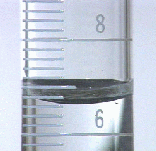
Figure 6. Measuring volume
Pipette practice:
- Obtain water in a small beaker, a ten ml sterile graduated pipette, and a pipette aid (pipump). Take a minute to note the divisions on the pipette and to empathise what volume each mark represents. Use of the pipette to transfer liquids will exist demonstrated. Before trying to pipette a sterile liquid, practice drawing up 5 ml of water from the beaker, and releasing information technology dorsum into the beaker in 1 ml increments. Continue until you lot feel comfy holding the pipette and using the pipump. So practise it again with water in a capped media canteen using hygienic techniques.
A portion of a ten mL graduated pipette is shown in Figure half dozen. What is the volume of liquid in this pipette?
Volume:________________________________
Solid and semi-solid media
Growing cultures of bacteria on solid media (agar plate or slant) permits united states of america to view and identify colonial characteristics, and too provides a way to split bacteria in a mixed civilisation. Cultures grown on agar plates ordinarily don't survive for long, since Petri dish lids are not tight fitting and the media (and leaner) dehydrate. Cultures grown on agar plates should always be handled "bottom-up" to forestall condensation—which often accumulates on the chapeau of the dish during incubation—from dripping down on the culture.
Bacteria may be grown in agar slant or stab media in tubes if the purpose is to maintain them in a longer term civilisation. Generally, bacteria grown on slants will remain feasible for a few weeks to a few months, and sometimes longer if stored in a refrigerator.
In this laboratory, you will exist introduced to aseptic techniques and basic lab skills needed to grow and maintain bacteria in culture. You volition be applying these skills often, so mastery is of import.
Method
A volunteer from your lab bench should obtain one of each of the post-obit cultures:
- TSA streak plate civilization of Micrococcus luteus and Enterococcus faecalis
What BSL containment level practices should exist used?
M . luteus__________________
E . faecalis__________________
- A "mixed culture" in TSB that contains two different bacteria
Below, write the names of the two bacteria in the mixed culture and the appropriate BSL, as specified past your teacher:
Mixed culture bacterium 1 ____________________________________________________
Mixed civilisation bacterium 2 ____________________________________________________
The techniques needed volition showtime exist demonstrated past your teacher. Later on the sit-in, perform the following tasks, and record your observations/results.
Broth Subculture
Obtain 2 sterile glass culture tubes, a bottle of Tryptic Soy Broth (TSB) and a examination tube rack. With pocket-sized pieces of colored tape, label each tube with your name and either "South" for subculture, or "C" for command. Using aseptic technique, use a x ml graduated pipette to transfer 2 ml of goop to each tube.
As demonstrated, employ a flame-sterilized inoculating loop to option upwardly from the surface of the M . luteus streak plate civilisation, a single colony (if small) or a function of a colony (if large) and transfer information technology to the broth in the tube labeled "Southward." Add zero to the second tube "C" which will serve as a sterility command. Note how the broths look immediately after you inoculate them (they should still look generally clear). Bacterial growth in broths is indicated past the development of a cloudy appearance. If the newly inoculated broth looks cloudy at the offset, you will accept no style to determine if this is due to bacterial growth during the incubation menses. If your broth looks cloudy, discard it and make another broth using less bacteria.
Place the broth subcultures in an incubator at the temperature and time specified by your instructor.
Streak Plate
Separation of a mixed civilization into individual colonies that can exist subcultured to make pure cultures depends on how well the streak plate is prepared. The goal of streak plate method is to dilute the cells by spreading them out over the surface of the agar. This is accomplished in stages, as volition be demonstrated in lab before yous try information technology yourself.
Use the simulated agar surface below to do the streak pattern using a pen or pencil.

Obtain two TSA plates, and write your name on the lesser half (the one-half containing the media) around the edge and following the bend (then the writing won't hide your view of the bacterial colonies in one case they grow). Also write M . luteus on one plate (the name of the bacteria you lot will subculture to this plate). On the other, write "mixed" to indicate that you lot're subculturing from the mixed culture broth to this plate.
As demonstrated, use a sterilized inoculating loop to pick up i M . luteus colony (or a piece of a colony) and transfer it to the surface of the agar plate. Spread the bacteria over approximately a quarter of the plate, edge to edge. Consider this step one.
Flame the loop and cool it in the agar. Overlap the step 1 streak 3-iv times to pull out a reduced number of leaner, and spread them out down the side of the plate. Consider this step ii.
Flame the loop and cool it in the agar. Overlap the stride ii streak 3-four times and spread over the surface. Keep this process, flaming the loop in between each step, until the entire surface of the agar plate is covered.
Afterwards performing this with the Yard . luteus culture for practice, repeat the process with a drib of the mixed civilization broth that you transfer to the plate with a sterile inoculating loop.
Identify the streak plate subcultures in an incubator at the temperature and time specified past your instructor.
Slant Subculture of M . luteus
Obtain i camber tube containing TSA, and label information technology using a pocket-sized piece of tape with your name and civilization name (Thou . luteus). Using a sterilized inoculating loop, pick up a bacterial colony (or piece of a colony) from the surface of the plate culture of M . luteus, and inoculate the surface of the slant. Place the slant subculture in an incubator at the temperature and fourth dimension specified by your teacher.
Stab or Deep Tube Subculture of Eastward . faecalis
Obtain one stab tube containing semisolid TSA, and label it using a small slice of tape with your name and civilisation proper name (E . faecalis). Using a sterilized inoculating needle, choice upwards a bacterial colony (or piece of a colony) from the surface of the plate culture of East . faecalis, and inoculate the media by stabbing the needle into the middle of the agar in the tube,and pushing it downwards to the lesser. Withdraw the needle carefully and try to remove it by post-obit the same stab line that y'all made pushing the needle down. Identify the stab subculture in an incubator at the temperature and fourth dimension specified past your teacher.
A note nigh incubation temperatures
As you volition larn, bacteria have preferred growth temperatures where their reproduction rate is the greatest. All of the bacteria we piece of work with in lab are mesophilic, which means that they grow at temperatures between 20–forty°C. However, some prefer body temperature (37°C), while others grow best at room temperature (approximately 25°C). This lab is equipped with incubators set at either temperature.
How long you lot plan to go out your cultures in an incubator should also be a consideration. Growing cultures at the higher temperature may speed their rate of growth, but information technology besides causes dehydration of the media and an earlier demise to the bacteria in the culture.
As a general rule, for bacteria that abound best at body temperature, if you intend on returning to lab within 24 to 36 hours (highly recommended), and then incubate them at 37°C. If you lot cannot render to lab during an "open up lab" period, so incubate them at room temperature, or accommodate to have your cultures transferred to a refrigerator afterwards they grow, then that the culture won't die out before you can finish your experiments. Bacteria that abound best at room temperature should always exist incubated at room temperature, and growth may have a little longer.
Master culture from an environmental source—you!
With your introduction to basic bacteriological culturing techniques complete, information technology's time to utilise those skills. Today is the get-go of The Human Skin Microbiome Project, which starts with the master civilisation of bacteria from your skin on TSA medium. It is important that you read the project description (in the next chapter) then that you understand the goals and the telescopic of the project.
To begin, you lot volition have a sample from your skin. Your first conclusion will be what part of your pare exercise you lot want to sample? Note: But external peel surfaces are permitted.
Obtain a sterile swab and a tube of sterile distilled water, and label a TSA plate with your proper noun and the appointment. Remove the wrapping from the swab and soak it in sterile water, using aseptic technique.
Rub the moisture swab back and forth firmly over the area of skin y'all take chosen to sample. And then rub the swab over approximately a third of the surface of the TSA agar plate.
Sterilize an inoculating loop, and complete the rest of the streak plate blueprint using the loop. Incubate this plate at room temperature for up to a week.
After incubation, wait to meet if isolated colonies have developed on the plate. If there are no colonies or no isolated colonies, you volition need to make another streak plate with the advice of your teacher on how to proceed. If at that place are isolated colonies, transfer the plate to the fridge. From this plate you will ultimately choose i single colony and prepare a pure culture. The criteria for colony selection and next steps are described in the side by side chapter, "The Human Pare Microbiome Project."
To consummate the lab , the bacteria in the cultures accept to abound . Therefore , the following observations are fabricated Later the cultures have had time to grow .
Observations and Outcomes
Broth subcultures
Look at the broth subculture tubes, and describe what yous expected to see, and how they announced in terms of how "cloudy" they look—cloudiness is an indication of bacterial growth.
| Cloudiness of broth earlier incubation | Predicted appearance of broth after incubation | Actual advent of broth later on incubation | |
| Grand. luteus subculture ("S") | |||
| Sterility Control ("C") |
Streak plate subcultures
Look at the streak plate subcultures that y'all made. Conduct a cocky-assessment of how well y'all performed the technique. What you hope to see are individual colonies, well separated from each other. On the streak plate of the mixed culture, you should exist able to see two distinctly different types of colonies.
1000 . luteus streak plate:
- Are the colonies well separated?
- How many unlike types of colonies exercise you encounter?
- Describe in full the colonial morphology of the bacteria on this plate:
Streak plate of the mixed culture :
- Are the colonies well separated?
- Could you make a pure culture of both bacteria from this plate? If you think you lot can, subculture a single colony of each type to one half of a TSA plate, divided by drawing a line with a marking on the bottom of the plate, as shown beneath. Incubate the plate, and then observe to come across if you successfully separated the two bacteria in the mixed culture into two pure cultures. Use this self-analysis to consider improvements you might brand in the technique you applied to making the streak plate.

- Describe in full the colonial morphology of both of the bacteria from the mixed culture:
| Colony Type 1 | Colony Blazon two | |
| Size | ||
| Texture | ||
| Transparency | ||
| Pigmentation | ||
| Whole Colony |
TSA slant subculture
Examine the subculture of M . luteus y'all prepared on the TSA slant.
- Draw the texture , transparency , and pigmentation of the bacterial growth on the slant. But these characteristics can be described for a slant culture, since there should be no discreet colonies on the slant, only an area of dense growth along the streak line.
- Does your description lucifer what was noted for the M . luteus colonies when you described the colonial morphology previously?
- Do you see bear witness of any other type of bacteria (significant a different colonial morphology) on the slant?
- Is this a pure culture?
TSA stab subculture
Look closely forth the stab line in the media in the tube. Exercise y'all see evidence of bacterial growth? If yes, describe and/or sketch how it appears.
Semisolid agar of the type used in this exercise can exist used as a way to evaluate if a bacteria is motile, pregnant in possession of one or more flagella that facilitates movement through liquids or semisolids. The mode to evaluate motility is to look closely at the line of inoculation you created when the tube was stabbed. Nonmotile bacteria will grow along the stab line just. If they are motile, they will be able to motion through the semisolid agar (similar pond through jello), and you lot won't be able to see a singled-out line in the agar—just cloudiness surrounding the stab line.
- Based on your observation of the bacteria in the stab civilization, is there evidence that the leaner are motile?
- For bacteria, the power to move (motility) requires that they accept which specific cellular structure?
0 Response to "Can a Pure Culture Be Prepared From a Mixed-broth or a Mixed-agar-slant Culture"
ارسال یک نظر